
Acetic acid
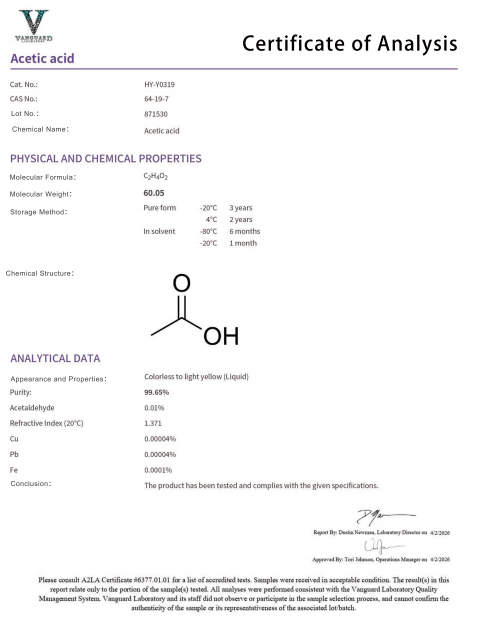
Cat. No.: HY‑Y0319 CAS No.: 64‑19‑7 Molecular Formula: C₂H₄O₂ Molecular Weight: 60.05 Target: Endogenous Metabolite; AMPK; Reactive Oxygen Species (ROS); Caspase; PPAR; Fungal Pathway: Metabolic Enzyme/Protease; Epigenetics; PI3K/Akt/mTOR; Immunology/Inflammation; NF‑κB; Apoptosis; Cell Cycle/DNA Damage; Vitamin D Related/Nuclear Receptor; Anti‑infection Storage Condition: Pure form: -20°C, 3 years; 4°C, 2 years In solvent: -80°C, 6 months; -20°C, 1 month
BIOLOGICAL ACTIVITY
Acetic acid is a carboxylic acid and short‑chain fatty acid (SCFA). Acetic acid can activate AMPK, increase ROS, cleaved caspase‑9 and PPARα, and down‑regulate the expression of SREBP‑1c and ChREBP. Acetic acid exhibits antifungal activity against Saccharomyces cerevisiae W303‑1A. Acetic acid regulates energy metabolism. Acetic acid shows anti‑cancer activity against gastric cancer. Acetic acid can induce writhing response and ulcerative colitis. Acetic acid can be used in the research of gastric cancer, ulcerative colitis, hepatic steatosis and pain.
IC₅₀ & Target: Microbial Metabolite, Human Endogenous Metabolite, PPARα, Caspase 9
In‑vitro Study
Acetic acid (2‑5 μM; 24 h) induces selective death of gastric cancer cells (RGK1) through oxidative stress, while having minor effects on normal gastric mucosal cells (RGM1). Acetic acid (20‑200 mM; 200 min) induces programmed cell death in Saccharomyces cerevisiae W303‑1A. Acetic acid (5 mM; 15 days) inhibits the elevation of disaccharidase (sucrase, maltase, trehalase, lactase) activities in Caco‑2 cells, but does not affect cell growth or glucose transport. Acetic acid (1.8‑7.2 mM; 3 h) activates the AMPKα signaling pathway by consuming ATP, thereby increasing the AMP/ATP ratio in bovine hepatocytes, up‑regulating lipid‑oxidation‑related genes, down‑regulating lipogenic genes, and reducing intracellular triglyceride content. MCE has not independently confirmed the accuracy of these methods. They are for reference only.
Western Blot Analysis Cell Line: Rat gastric mucosal cells (RGM1), cancerous gastric mucosal cells (RGK1) Concentration: 0, 1, 2, 5, 10, 20 μM Incubation Time: 24 h Result: Increased monocarboxylic transporter 1 (MCT1) and cleaved caspase‑9 in RGK1 cells. Showed minor effects in RGM1 cells.
Cell Line: Bovine hepatocytes Concentration: 1.8 mM, 3.6 mM, 7.2 mM Incubation Time: 3 h Result: Increased AMPKα phosphorylation and activity, upregulated PPARα expression, downregulated SREBP‑1c and ChREBP expression.
In‑vivo Study
Acetic acid (0.56%; intraperitoneal injection) can significantly induce writhing response in C57BL/6J mice. Acetic acid (5% v/v; rectal instillation) can induce ulcerative colitis in mice, resulting in weight loss, diarrhea, colonic inflammation and tissue injury. MCE has not independently confirmed the accuracy of these methods. They are for reference only.
REFERENCES
[1]. Granado‑Serrano AB, et al. Faecal bacterial and short‑chain fatty acids signature in hypercholesterolemia. Sci Rep. 2019 Feb 11;9(1):1772. [2]. Syka JE, et al. Peptide and protein sequence analysis by electron transfer dissociation mass spectrometry. Proc Natl Acad Sci U S A. 2004 Jun 29;101(26):9528‑33. [3]. Barbier Jr J, et al. Total oxidation of acetic acid in aqueous solutions over noble metal catalysts. Journal of Catalysis, 1998, 177(2): 378‑385. [4]. Terasaki M, et al. Acetic acid is an oxidative stressor in gastric cancer cells. J Clin Biochem Nutr. 2018 Jul;63(1):36‑41. [5]. Ludovico P, et al. Saccharomyces cerevisiae commits to a programmed cell death process in response to acetic acid. Microbiology (Reading). 2001 Sep;147(Pt 9):2409‑2415. [6]. Ogawa N, et al. Acetic acid suppresses the increase in disaccharidase activity that occurs during culture of caco‑2 cells. J Nutr. 2000 Mar;130(3):507‑13. [7]. Li X, et al. Acetic acid activates the AMP‑activated protein kinase signaling pathway to regulate lipid metabolism in bovine hepatocytes. PLoS One. 2013 Jul 4;8(7):e67880. [8]. Stevenson GW, et al. Targeting pain‑suppressed behaviors in preclinical assays of pain and analgesia: effects of morphine on acetic acid‑suppressed feeding in C57BL/6J mice. J Pain. 2006 Jun;7(4):408‑16. [9]. Niu X, et al. Protective effect of sanguinarine against acetic acid‑induced ulcerative colitis in mice. Toxicol Appl Pharmacol. 2013 Mar 15;267(3):256‑65.

Reviews
There are no reviews yet.