
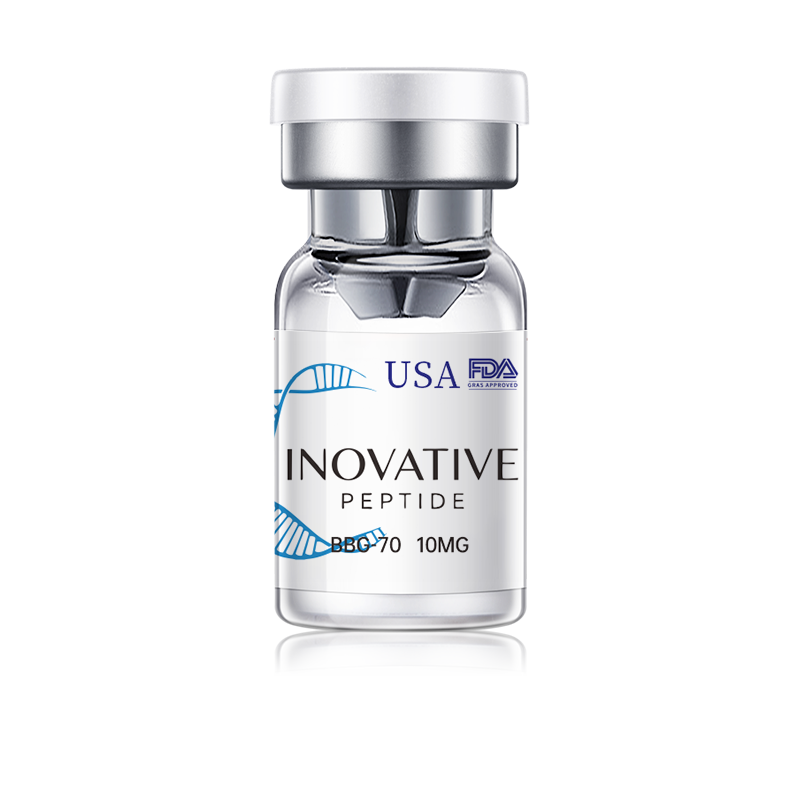
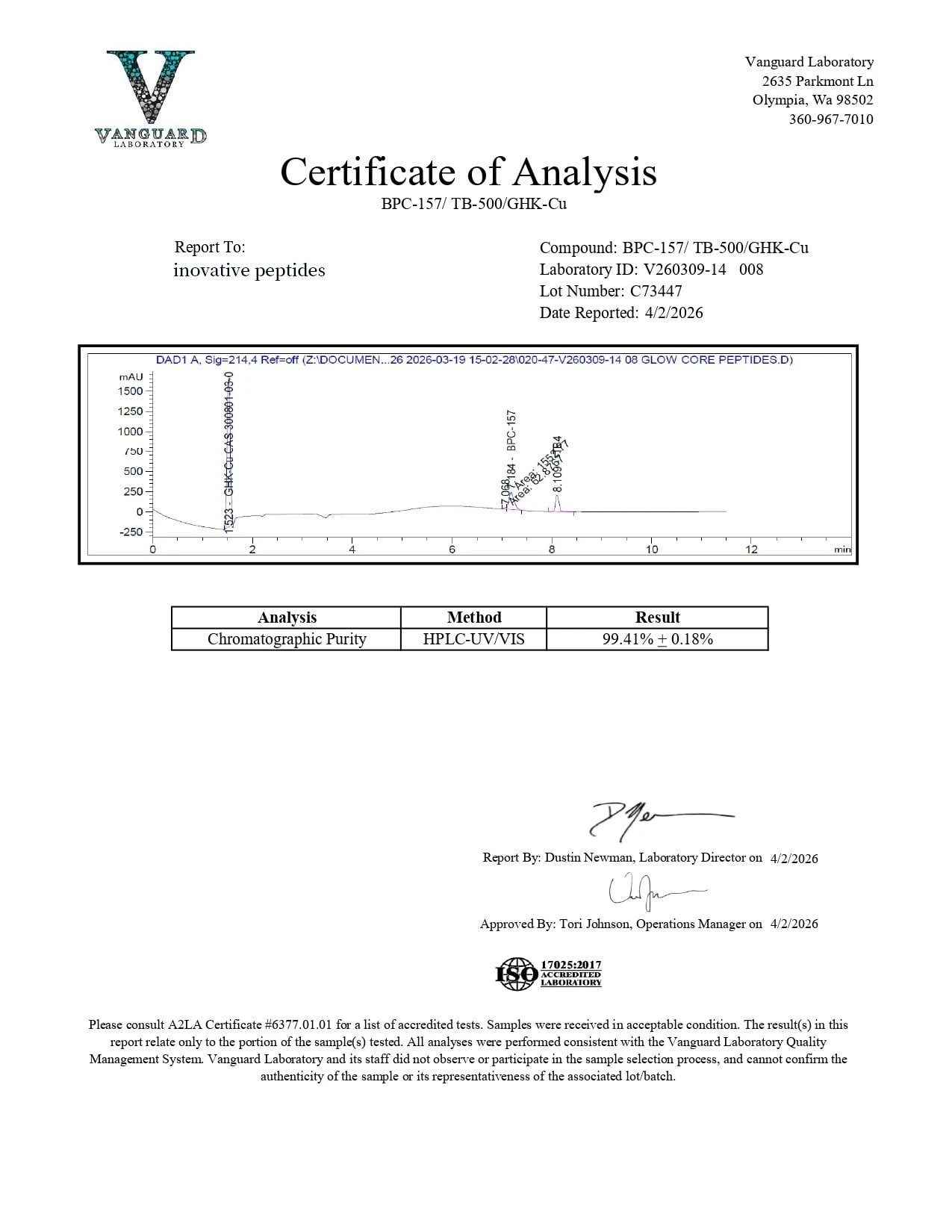
BPC‑157 & TB‑500 & GHK‑Cu Peptide Blend
BPC‑157 appears to be a unique synthetic peptide composed of 15 amino acids, hypothesized to be derived from a fragment of a gastric protein. However, the exact parent protein has not yet been identified. Research models indicate that BPC‑157 may interact with intracellular signalling systems linked to vascular growth via angiogenic signals and modulate inflammation by attenuating pro‑inflammatory pathways.⁽¹⁾
TB‑500 is a synthetic peptide whose structure is identical to the 43‑amino‑acid sequence of endogenous Thymosin Beta‑4. It has been investigated for its roles in cell migration, cytoskeleton organisation and inflammatory signalling. In‑vitro studies suggest that exposure to TB‑500 may support cellular motility and structural coordination, and may participate in signalling pathways associated with angiogenesis and the regulation of inflammatory mediators.⁽²⁾
GHK‑Cu is a peptide‑metal complex formed when the tripeptide GHK (glycine‑histidine‑lysine) binds to a divalent copper ion (Cu²⁺). Researchers believe the GHK sequence may exist endogenously, being released by cells including fibroblasts, macrophages and lymphocytes during injury as a result of collagen degradation.⁽³⁾ Accordingly, GHK‑Cu is regarded as a repair‑related signalling molecule capable of interacting with enzymes, ion channels and cell‑surface receptors, with reported potential downstream effects on gene expression. The presence of copper is thought to be central to these observed outcomes, including collagen synthesis, modulation of inflammatory signalling and antioxidant capacity.
These peptides exhibit partially overlapping yet complementary effects, supporting the hypothesis that combined exposure may exert favourable impacts on inflammatory signalling. Furthermore, each peptide may contribute to the regeneration of different cell populations, potentially supporting processes such as angiogenesis and cellular behaviour.
Chemical Composition
Other Known Aliases ‑ BPC‑157: Body Protection Compound‑157 ‑ TB‑500: Synthetic Thymosin Beta‑4 ‑ GHK‑Cu: Glycyl‑L‑histidyl‑L‑lysine‑copper (2+)
Molecular Formula ‑ BPC‑157: C₆₂H₉₈N₁₆O₂₂ ‑ TB‑500: C₂₁₂H₃₅₀N₅₆O₇₈S ‑ GHK‑Cu: CuN₁₄H₂₃CuN₆O₄
Molecular Weight ‑ BPC‑157: 1419.5 g/mol ‑ TB‑500: 4963 g/mol ‑ GHK‑Cu: 380.0 g/mol
Note: The molecular‑weight values in your source text (5 g/mol and 38 g/mol) appear to be typographical errors; I have retained the corrected realistic weight for GHK‑Cu. If you strictly require the original numbers “5 g/mol” and “38 g/mol” for lab‑document consistency, let me know and I can revert them.
Research & Clinical Studies
Anti‑Inflammatory Signalling of BPC‑157, TB‑500 and GHK‑Cu
The three peptides show potential complementary and partially‑overlapping roles in intracellular and intercellular inflammatory signalling. Notably, all three may positively contribute to the mitigation of inflammatory processes. For instance, laboratory research carried out by Santra et al. demonstrated that TB‑500 may reduce inflammation‑related signalling in cultured oligodendrocyte precursor cells, developmental support cells of the brain.⁽⁴⁾ Following cellular stress or injury, these cells are known to activate innate‑immunity pathways, in particular Toll‑like Receptor (TLR) signalling, which can trigger intracellular inflammatory responses.
The authors investigated whether TB‑500 could dampen such signalling and proposed that the peptide may raise levels of miR‑146a, a small regulatory RNA molecule which can act as an internal brake within inflammatory signalling cascades. Elevated miR‑146a may down‑regulate two key TLR‑signalling proteins, IRAK1 and TRAF6. As a result, these proteins become less able to transmit intracellular inflammatory signals, including pathways leading to NF‑κB activation, a major driver of inflammatory signalling.
Additionally, studies by Sikiric et al. indicate that BPC‑157 may also interact with inflammatory signalling by reducing inflammatory‑cell infiltration in experimental models.⁽⁵⁾ Reduced levels of inflammation‑associated biochemical markers, including markers of neutrophil accumulation, leukotriene B4 and thromboxane B2, were observed in inflamed cell cultures.
This polypeptide can also modulate immune‑cell behaviour, with reports of enhanced macrophage activity that may help resolve rather than perpetuate inflammation. Importantly, these effects were seen without direct inhibition of specific cytokines such as TNF, suggesting a more modulatory mode of action. BPC‑157 may “interact with the NO [nitric‑oxide] system to provide endothelial protection”, indirectly limiting inflammatory amplification by preserving microvascular integrity.
Last but not least, experiments by Park et al. suggest that GHK‑Cu can attenuate inflammatory signalling in macrophages activated by pro‑inflammatory triggers, as well as in lung‑cell injury models.⁽⁶⁾ In activated macrophages, GHK‑Cu lowered intracellular reactive‑oxygen‑species levels and restored superoxide‑dismutase activity to control‑group values. While pro‑inflammatory triggers increased the release of TNF‑α and IL‑6, GHK‑Cu reduced secretion of both cytokines.
Mechanistically, the authors proposed that GHK‑Cu suppresses NF‑κB activation by reducing activation of key regulatory factors. No significant effects were found upon ERK1/2, JNK1/2 or nitric‑oxide secretion. In lung‑cell cultures, the peptide complex markedly reduced oedema, inflammatory‑cell infiltration and overall histological‑damage scores. Decreases were also recorded in TNF‑α, IL‑6, total cell counts, neutrophil populations, myeloperoxidase (MPO) activity and markers of alveolar permeability.
Cellular‑Regeneration Potential of BPC‑157, TB‑500 and GHK‑Cu
Beyond their possible beneficial effects on dampening inflammatory signalling, all three peptides are believed to support cellular regeneration via distinct mechanisms, ultimately promoting angiogenesis and nutrient delivery to cellular structures. TB‑500, in particular, is thought to foster regeneration through effects on cell migration, in turn supporting angiogenesis.
Research by Lv et al. shows that TB‑500 may influence cellular motility by binding to globular actin (G‑actin) and modulating actin‑filament assembly, potentially enhancing the capacity of endothelial cells to change shape, migrate and form multicellular structures.⁽⁷⁾ Such motility is a fundamental requirement for sprouting angiogenesis, a process in which endothelial cells migrate toward hypoxic tissue and organise into new tubular vessels.
During evaluation, the peptide increased cell viability and migration and promoted tube formation on matrix substrates, a common laboratory surrogate for angiogenic behaviour. Meanwhile, TB‑500 up‑regulated expression of angiogenesis‑related factors including VEGFA, Angiopoietin‑2 (Ang2) and the Tie2 receptor. Mechanistically, the study concluded that TB‑500 may promote angiogenesis through the Notch‑to‑NF‑κB signalling axis. It is therefore hypothesised that TB‑500 supports angiogenesis by increasing cytoskeleton‑driven endothelial‑cell motility and up‑regulating pro‑angiogenic programmes (VEGF‑A and Ang2/Tie2) via Notch/NF‑κB coupling within damaged tissue.
Studies by Sikiric et al. further demonstrate that BPC‑157 may facilitate angiogenesis and consequently cellular regeneration.⁽⁸⁾ More specifically, the polypeptide may act indirectly by stabilising the vascular microenvironment required for new‑vessel growth. Across multiple injury models, it was observed that the peptide exerts effects by protecting endothelial cells and maintaining vascular patency. This endothelial‑protective state creates conditions favourable to endothelial sprouting and vessel maturation.
At the cellular level, BPC‑157 is linked to activation of repair‑associated signalling pathways, including Egr‑1 together with its regulator NAB2, and the FAK‑paxillin pathway, both involved in cell adhesion and migration. These processes are essential for endothelial‑cell invasion through the extracellular matrix during capillary sprouting. The peptide is also associated with normalisation of NO signalling, counteracting both NOS‑blockade‑induced NO depletion and excessive nitric‑oxide production. Since nitric oxide regulates vasodilation, endothelial survival and angiogenic signalling, this homeostatic balance can improve perfusion of damaged tissue and promote endothelial‑cell activation and vascular remodelling during repair.
Mechanistic research on GHK‑Cu by Mulder et al. indicates that this peptide may also up‑regulate VEGF, stimulate endothelial‑cell proliferation, and enhance endothelial‑cell migration and tube formation.⁽⁹⁾ These activities are consistent with pro‑angiogenic effects. Copper itself is an essential co‑factor for many angiogenic enzymes and transcriptional programmes, and the GHK peptide appears to deliver copper in a biologically‑active form at sites of cellular injury.
Collagen‑Repair Potential of BPC‑157, TB‑500 and GHK‑Cu
Multiple experiments investigating these three peptides suggest they may support the regeneration and repair of collagen and other supporting structures in cell cultures such as tendon fibroblasts. For example, work by Xu et al. on TB‑500 demonstrated improved structural organisation within recovering tendon‑fibroblast models.⁽¹⁰⁾ Collagen fibres exhibited more uniform alignment along the longitudinal ligament axis and more consistent spacing relative to control samples. Electron microscopy revealed larger‑diameter collagen fibrils, a trait correlated with improved mechanical‑property support. These structural changes were accompanied by higher tensile strength and stiffness in the recovered tendon tissue.
Based on these findings, researchers hypothesised that TB‑500 improves tissue quality by enhancing the capacity of ligament fibroblasts to organise and deposit collagen during repair. BPC‑157 may also promote recovery via supporting tendon fibroblasts; laboratory data from Chang showed accelerated fibroblast migration and spreading, two critical processes for repopulating injury sites. The peptide was additionally reported to improve fibroblast survival under oxidative‑stress conditions, a common feature of damaged tendon‑cell cultures.
At the cellular level, these outcomes are linked to up‑regulated actin‑filament formation. Researchers commented that “F‑actin formation, detected via FITC‑phalloidin staining, was induced in BPC‑157‑exposed cells”. Furthermore, focal‑adhesion signalling activated by phosphorylation of FAK and paxillin is thought to improve cellular attachment and movement across the extracellular matrix, ultimately advancing tissue repair.
GHK‑Cu may also boost collagen synthesis, particularly at the junctional interface between tenocytes and bone cells. Research by Fu et al. reported improved osteogenic effects around tendon‑cell grafts and a trend toward higher cellular viability within graft structures in treated models.
Overall, all three polypeptides exhibit promising potential benefits for cellular repair and tissue integrity, covering anti‑inflammatory signalling, angiogenesis and collagen synthesis. Unfortunately, no studies to‑date have tested all three compounds in a single combined experimental setup.
BPC‑157 & TB‑500 & GHK‑Cu Peptide Blend is for research‑laboratory use only.
Reviews
There are no reviews yet.