
Benzyl alcohol
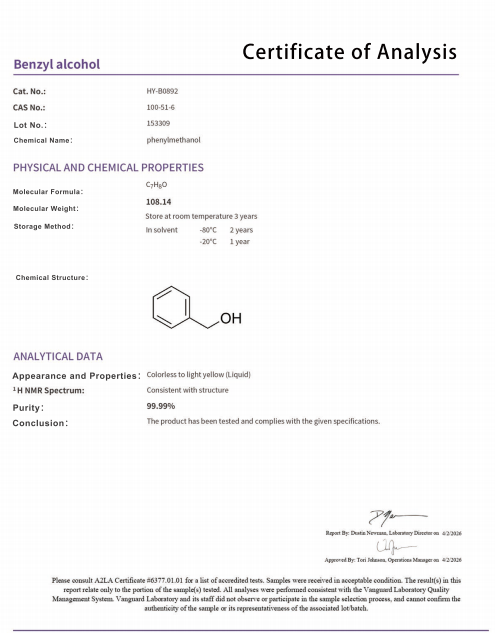
Cat. No.: HY‑B0892 CAS No.: 100‑51‑6 Molecular Formula: C₇H₈O Molecular Weight: 108.14 Target: Environmental Pollutants; Cytochrome P450; Toll‑like Receptor (TLR) Pathway: Others; Metabolic Enzyme/Protease; Immunology/Inflammation Storage Condition: Store at room temperature, 3 years In solvent: -80°C, 2 years; -20°C, 1 year
Solubility Data
In Vitro
DMSO: 100 mg/mL (924.73 mM; Need ultrasonic) H₂O: 100 mg/mL (924.73 mM; Need ultrasonic)
Stock Solution Preparation
1 mM: 9.2473 mL (1 mg), 46.2364 mL (5 mg), 92.4727 mL (10 mg) 5 mM: 1.8495 mL (1 mg), 9.2473 mL (5 mg), 18.4945 mL (10 mg) 10 mM: 0.9247 mL (1 mg), 4.6236 mL (5 mg), 9.2473 mL (10 mg)
Select an appropriate solvent to prepare the stock solution according to the solubility of the product in different solvents. Once prepared, aliquot and store the solution to avoid product failure caused by repeated freeze‑thaw cycles. Storage conditions and shelf‑life of stock solution: -80°C, 2 years; -20°C, 1 year. Use within 2 years when stored at -80°C, and within 1 year when stored at -20°C.
In Vivo
Select an appropriate dissolution protocol based on your experimental animals and administration route. For all the following protocols, first prepare a clear stock solution as described in the In‑Vitro section, then add cosolvents sequentially.
To ensure reliable experimental results, clear stock solutions may be stored appropriately under recommended conditions. Working solutions for in‑vivo assays are recommended to be freshly prepared and used on the same day. The percentage shown before each solvent refers to its volume proportion in the final solution. If precipitation occurs during preparation, heating and/or ultrasonication can be applied to aid dissolution.
- Add solvents in sequence: PBS Solubility: 33.33 mg/mL (308.21 mM); Clear solution; Need ultrasonic
- Add solvents in sequence: 10 % DMSO → 40 % PEG300 → 5 % Tween‑80 → 45 % saline Solubility: ≥ 2.5 mg/mL (23.12 mM); Clear solution This protocol yields a clear solution of ≥ 2.5 mg/mL (23.12 mM, saturation unknown). Take 1 mL working solution as an example: add 100 μL clear 25.0 mg/mL DMSO stock solution into 400 μL PEG300 and mix well; add 50 μL Tween‑80 to the mixture and mix thoroughly; finally add 450 μL normal saline to make up to 1 mL.
- Add solvents in sequence: 10 % DMSO → 90 % (20 % SBE‑β‑CD in saline) Solubility: ≥ 2.5 mg/mL (23.12 mM); Clear solution This protocol yields a clear solution of ≥ 2.5 mg/mL (23.12 mM, saturation unknown). Take 1 mL working solution as an example: add 100 μL clear 25.0 mg/mL DMSO stock solution into 900 μL 20 % SBE‑β‑CD saline solution, then mix well.
BIOLOGICAL ACTIVITY
Benzyl alcohol is an aromatic alcohol, a colourless liquid with a mild aromatic odour. Benzyl alcohol is a cytochrome P450 inhibitor. Benzyl alcohol alleviates the inflammatory response of liver injury in mice via Toll‑Like Receptor‑4.
IC₅₀ & Target: Microbial Metabolite
In‑vitro Study
Benzyl alcohol (10‑80 mM) modulates cyclic‑AMP synthesis by increasing membrane fluidity in intact renal epithelial MDCK cells. Benzyl alcohol (0‑46 mM, 48 h) inhibits APAP (HY‑66005)‑induced hepatotoxicity by suppressing cytochrome P450 enzyme activity in primary mouse hepatocytes. MCE has not independently confirmed the accuracy of these methods. They are for reference only.
In‑vivo Study
Benzyl alcohol (270 mg/kg, i.p., 0.5‑24 h) attenuates acetaminophen (HY‑66005)‑induced liver injury. Benzyl alcohol (270 mg/kg, i.p., 3‑24 h) reduces inflammasome activation in a TLR4‑dependent manner. MCE has not independently confirmed the accuracy of these methods. They are for reference only.
Animal Model: APAP‑induced liver injury model in mice[2] Dosage: 270 mg/kg Administration: i.p. Result: Attenuated the increase in ALT activities and reduced areas of necrosis at both 6 h and 24 h. Reduced APAP metabolic activation and parameters of oxidant stress. Reduced APAP‑induced mitochondrial dysfunction.
Research Publications Using This Product
- Chem Sci. 2025 Oct 3.
- Turk J Med Sci. 2025 Feb 19;55(2):509‑517.
- ChemRxiv. 2025 May 9.
See more customer validations on www.MedChemExpress.cn
REFERENCES
[1]. Friedlander G, et al. Benzyl alcohol increases membrane fluidity and modulates cyclic AMP synthesis in intact renal epithelial cells. Biochim Biophys Acta. 1987 Oct 2;903(2):341‑8.
[2]. Du K, et al. Benzyl alcohol protects against acetaminophen hepatotoxicity by inhibiting cytochrome P450 enzymes but causes mitochondrial dysfunction and cell death at higher doses. Food Chem Toxicol. 2015 Dec;86:253‑61.

Reviews
There are no reviews yet.